Magnolia
What Is the Magnolia Tree and Why Gardeners Prize It?
Magnolia is a group of iconic flowering trees and shrubs in the genus Magnolia, celebrated for large, fragrant blooms that often appear before the leaves. Depending on the species, magnolias grow as small ornamentals or forest trees reaching about 3–30 m at maturity, with exceptional species approaching 35–40 m.
Native magnolias occur across eastern North America, Central America and the Caribbean, and eastern and southeastern Asia, with greatest diversity in China and the Himalayas-to-Japan region. As early-evolving Flowering plants (angiosperms), magnolias are botanically significant, and they remain economically important as ornamentals and, for some species, as timber.
The Magnolia’s Scientific Classification in the Family Magnoliaceae
In modern Plant taxonomy, the genus Magnolia is placed in the family Magnoliaceae within the order Magnoliales. Magnoliaceae contains roughly 200–300 species in total, and Magnolia itself includes about 200+ recognized species (counts vary by authority and by how formerly separate genera are treated).
Because “Magnolia” can mean the whole genus rather than one species, many well-known trees are best referenced by species name, such as southern magnolia (Magnolia grandiflora) and sweetbay magnolia (Magnolia virginiana). Across the genus, most species are diploid, but hybridization is common in cultivation, producing many named garden cultivars.
Magnolia Bark, Leaves, Flowers, and Cone-Like Fruit Structures
Magnolias typically form a straight trunk with smooth to lightly fissured bark, gray to brown, becoming rougher with age. Mature trunk diameter often ranges from 30–90 cm in common landscape trees, while large forest-grown specimens of big species can exceed 1–1.5 m in diameter.
Leaves are simple, alternate, and often glossy, with entire margins and prominent midribs; leaf length commonly ranges 8–25 cm, though some species are smaller or much larger. The genus spans both Deciduous trees species that drop leaves in winter and Evergreen trees species that keep foliage year-round, influencing where they are planted and how they behave seasonally.
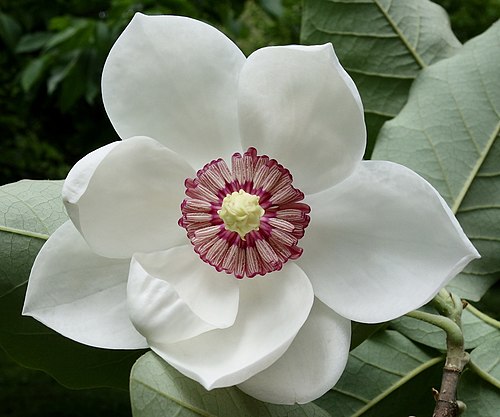
The flowers are the hallmark: large, showy, and often strongly scented, with petal-like tepals commonly 6–12 (sometimes more) and diameters frequently 8–25 cm. Magnolia reproductive parts are arranged on a central cone-like receptacle, a form often described as “primitive” among angiosperms.
After flowering, many magnolias develop an aggregate fruit that resembles a small cone, typically 5–15 cm long. As follicles split, bright red or orange seeds may dangle briefly on threads, aiding animal dispersal and making the fruit ornamental even after bloom.
Where Magnolia Species Grow: Forest Edges, River Bottoms, and Asian Montane Slopes
Magnolia species collectively span USDA hardiness zones roughly 4–11, with individual species adapted to specific climates. Many North American magnolias favor humid temperate to subtropical conditions, while numerous Asian species thrive in monsoonal climates and mid-elevation mountain forests.
Soil preferences vary, but magnolias generally perform best in moist, well-drained, slightly acidic to neutral soils (often around pH 5.0–7.0). In the wild, they are frequently found on forest margins, sheltered slopes, and riparian corridors where summer moisture is reliable and roots can spread in cool, humus-rich topsoil.
How Magnolia Trees Support Wildlife and Ancient Pollination Strategies
Magnolias are notable for their relationship with insects, including beetles, and are frequently cited in discussions of Pollination biology. Many species produce sturdy floral tissues and abundant pollen, features that can accommodate beetle visitors that crawl within the flower rather than delicately landing on petals.
This association is central to the concept of Beetle pollination, in which flowers offer pollen (and sometimes heat or shelter) more than nectar. Magnolia flowers can also be visited by bees and other insects, and in some habitats their early-season bloom provides critical resources when few other woody plants are flowering.
Ecologically, magnolias store carbon as long-lived woody perennials: a mature landscape magnolia of 10–20 m may contain on the order of several hundred kilograms of carbon in aboveground biomass, while large forest trees can store 1–3+ metric tons of carbon depending on size and wood density. Their seeds and fruiting structures feed birds and small mammals, and their canopies provide nesting cover in both natural forests and urban habitats.
Magnolia in Horticulture, Timber, Fragrance, and Cultural Symbolism
Magnolias are among the most planted ornamental trees in temperate and subtropical landscapes, valued for dramatic spring flowers, attractive foliage, and, in evergreen species, year-round screening. In gardens, typical cultivated heights range 4–15 m, while compact forms may stay under 3–5 m and large evergreens like M. grandiflora commonly reach 18–30 m over time.
Several species have commercial timber value, particularly in parts of Asia; magnolia wood is generally light-colored, fine-textured, and workable, used for interior joinery, carving, and veneers. In North America, “yellow-poplar” or tuliptree (Liriodendron tulipifera) is in the same family and sometimes discussed alongside magnolias for wood, but it is a different genus.
Fragrance is another major human draw: blooms of many species are lemony, spicy, or sweet, and their scent has influenced perfumery and garden design traditions. Culturally, magnolia blossoms are widely used as motifs in art and civic symbolism, and in the southern United States the evergreen magnolia has become an enduring emblem of hospitality and place.
Remarkable Facts About the Magnolia Tree
- Magnolia is a large genus with about 200+ recognized species, distributed mainly in eastern Asia and the Americas.
- Many magnolias flower at 8–25 cm across, and some cultivated forms can exceed 30 cm in diameter under ideal conditions.
- Common mature height ranges widely—about 3–30 m depending on species—while the biggest species can approach 35–40 m in forests.
- Trunk diameter is typically 30–90 cm in mature garden trees, but large forest specimens of big species can exceed 1–1.5 m.
- Longevity is substantial: many magnolias live 80–150 years, and favorable sites can support individuals for 200+ years.
- Magnolia fruits often reveal bright red or orange seeds, an adaptation that helps attract birds and other animals for dispersal.
- The genus includes both deciduous and evergreen species, letting gardeners choose between early-blooming spring silhouettes and year-round glossy foliage.