Space Race
What Was the Space Race Between the United States and the Soviet Union?
The Space Race was a decades-long competition between the United States and the Soviet Union to achieve firsts in spaceflight, from satellites to human landings on the Moon. It is usually dated from 1957—when the USSR orbited the first artificial satellite—to 1975, when the two rivals docked spacecraft in the Apollo–Soyuz Test Project, a span of about 18 years.
Although framed as peaceful exploration, the Space Race unfolded inside the larger Cold War contest for global influence, scientific prestige, and strategic deterrence. The struggle played out on launchpads from Kazakhstan to Florida, but its symbolism reached billions worldwide through radio, newspapers, and television.
The Cold War, Rocketry, and Missiles: Why the Space Race Began
World War II-era rocketry and German V-2 technology seeded postwar programs on both sides, but rivalry hardened after 1947 as the superpowers competed across Europe, Asia, and the developing world. Nuclear strategy mattered: the same boosters that could place payloads in orbit could also deliver warheads across continents via an Intercontinental ballistic missile.
Budgets and institutions followed geopolitics. In the United States, the shock of early Soviet successes helped drive the creation of NASA in 1958, consolidating civilian space efforts even as the military pursued its own launch and surveillance capabilities.
1957–1975: From Sputnik to Apollo–Soyuz in the Space Race Timeline
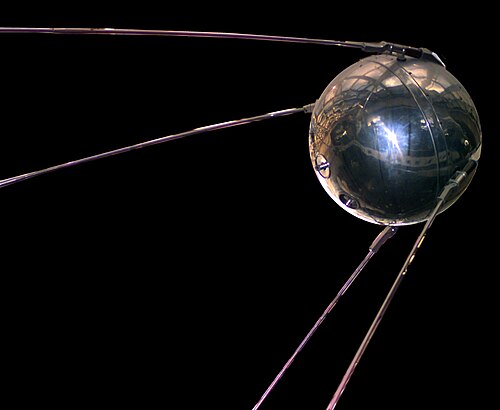
The Space Race erupted publicly on October 4, 1957, when the USSR launched Sputnik 1, a 58 cm-wide satellite weighing about 83.6 kg that orbited Earth roughly every 96 minutes. Its beeping radio signal was simple, but the demonstration was profound: an orbital launch implied rockets powerful enough to reach high altitudes and long distances, and it prompted urgent U.S. investment in science education and aerospace.
Human spaceflight raised the stakes again on April 12, 1961, when Yuri Gagarin flew Vostok 1—a single-orbit mission lasting about 108 minutes. The achievement accelerated U.S. political commitments, culminating in President John F. Kennedy’s May 1961 call to land a man on the Moon and return him safely to Earth “before this decade is out,” effectively setting a deadline of under 9 years.
Both nations advanced through increasingly complex missions: multi-person crews, spacewalks, rendezvous and docking, and long-duration flights. The USSR scored early firsts (first satellite, first human, first woman in space, and early spacewalk milestones), while the U.S. pushed rapid iteration through Mercury and Gemini to enable lunar flight.
The decisive symbolic moment arrived on July 20, 1969, when Apollo 11 landed in the Sea of Tranquility after traveling roughly 384,400 km to the Moon. Neil Armstrong and Buzz Aldrin spent about 2 hours 31 minutes outside the lunar module, while Michael Collins orbited above; the mission returned 21.5 kg of lunar samples and was watched by an estimated hundreds of millions of people worldwide.
After the Moon landing, the race shifted toward sustainability and diplomacy. The Soviet Union focused on space stations like Salyut and later Mir’s predecessors, while the United States wound down Apollo after six successful lunar landings (1969–1972) and redirected funds toward reusable concepts and Earth-orbit operations.
The period’s capstone was the Apollo–Soyuz Test Project in July 1975, when U.S. and Soviet spacecraft docked in orbit and crews conducted joint experiments. The docking did not end rivalry in every domain, but it marked a visible turn from pure competition toward managed cooperation.
The Leaders, Astronauts, and Engineers Who Drove the Space Race
At the political level, Soviet Premier Nikita Khrushchev leveraged early space successes as proof of socialist modernity, while U.S. presidents—especially Kennedy and later Lyndon B. Johnson and Richard Nixon—treated space milestones as measures of national capability. Space achievements became tools of foreign policy as well as domestic confidence, with appropriations rising and falling alongside public attention and strategic priorities.
Design bureaus and engineering teams were equally decisive. Sergei Korolev, long kept anonymous in Soviet media, coordinated the USSR’s early triumphs through R-7-derived launch systems, while U.S. programs relied on sprawling contractor networks and mission management inside NASA centers such as Marshall and Johnson.
The human faces of the Space Race—Gagarin, Valentina Tereshkova, Armstrong, Aldrin, Collins, and many others—represented the pinnacle of training and risk. Losses underscored the danger: the U.S. suffered the Apollo 1 fire in January 1967 that killed three astronauts during a ground test, while the USSR experienced fatal accidents including Soyuz 1 (1967) and Soyuz 11 (1971).
What the Space Race Changed: Technology, Treaties, and Spending
The Space Race reshaped technology and national priorities. At its peak in the mid-1960s, U.S. space spending reached roughly 4% of the federal budget; Apollo alone cost about $25.4 billion in 1960s dollars—often estimated at well over $150 billion in today’s money—supporting hundreds of thousands of jobs across states and major industrial suppliers.
Strategically, space became an arena for reconnaissance, communications, and navigation, strengthening command-and-control and intelligence gathering. Just as importantly, the competition pushed rules for space: the 1967 Outer Space Treaty established principles like non-appropriation of celestial bodies and limits on placing weapons of mass destruction in orbit, even though dual-use systems blurred lines between civilian science and military capability.
Scientific outcomes included lunar geology, solar and cosmic research, and the maturation of systems engineering—reliability practices, redundancy, and quality control needed for missions where a single failure could be fatal. The race also helped normalize global satellite infrastructure, with weather and communications satellites becoming routine by the early 1970s.
Why the Space Race Still Matters for Space Policy and New Space Powers
The Space Race remains a reference point for how quickly states can mobilize resources when national goals are clear, time-bounded, and politically resonant. Its legacy is visible in today’s launch industry, astronaut corps culture, and the expectation that major missions require coalitions of government, academia, and private contractors.
Modern lunar programs, commercial launch competition, and renewed geopolitical tensions echo Space Race dynamics, but with more participants and different economics. Where two superpowers once set the tempo, today multiple countries and private firms pursue orbit and lunar access, often building on the institutional and technical foundations laid between 1957 and 1975.
Key Facts About the Space Race (1957–1975)
- Timeframe: commonly dated from October 4, 1957 (Sputnik) to July 1975 (Apollo–Soyuz), about 18 years.
- First satellite: Sputnik 1 (USSR), mass ~83.6 kg, orbital period ~96 minutes.
- First human spaceflight: Vostok 1 (USSR), April 12, 1961, duration ~108 minutes.
- First Moon landing: Apollo 11 (USA), July 20, 1969; lunar distance ~384,400 km.
- U.S. civilian space agency: NASA created in 1958.
- Strategic link: orbital launch vehicles overlapped with Intercontinental ballistic missile development and deterrence doctrine.
- Approximate cost: Apollo program about $25.4 billion in 1960s dollars (often estimated at well over $150 billion today).
Did the Space Race “end” in 1969 with the Moon landing?
No. Apollo 11 was the most iconic turning point, but major competition continued through the early 1970s with additional lunar missions, Soviet space stations, and evolving military and scientific satellite programs. The 1975 Apollo–Soyuz docking is often used as a symbolic endpoint for the original phase.
Was the Space Race mainly about science or military power?
It was both. The public narrative emphasized exploration, but launch technology overlapped heavily with missile development, and satellites quickly became central to reconnaissance and communications. Scientific results were substantial, yet they advanced alongside strategic objectives.
Why did the Soviet Union lead early while the United States won the Moon race?
The USSR gained early momentum with powerful boosters and a focused design-bureau system that produced quick firsts like Sputnik and Gagarin. The United States responded by organizing a massive, well-funded effort with a clear deadline for a lunar landing, achieving the Moon goal through sustained industrial scale and program management.